- July 30, 2026
- By Suman Agarwal
A Complete Guide to Human Perception| ICBI
Introduction
For decades, the term Image Management has been misunderstood.
Ask ten people what it means, and most will describe clothing, grooming, etiquette, or fashion.
While these are certainly visible elements, they represent only a fraction of what truly shapes human perception.
Image Management is not about creating a false identity.
It is about ensuring that your external expression consistently reflects your internal capability.
Every day, people make hundreds of unconscious decisions about us.
Can I trust this person?
Should I follow this leader?
Does this professional inspire confidence?
Would I buy from them?
Would I hire them?
Would I vote for them?
Would I introduce them to my most valuable client?
These decisions are often made before a conversation has even begun.
Not because people are superficial.
Because the human brain has evolved to make rapid judgments in environments filled with uncertainty.
Image Management is therefore not a fashion discipline.
It is a behavioural science.
It examines how identity is translated into perception and how perception influences opportunity.
This framework is designed to explain that process.
Why Human Beings Judge Instantly
One of the greatest misconceptions about first impressions is that they are unfair.
In reality, they are adaptive.
The human brain processes an enormous amount of sensory information every second.
To function efficiently, it relies on mental shortcuts.
Within moments of meeting someone, we begin forming impressions about competence, confidence, warmth, credibility, and authority.
These impressions are not final.
But they often become the starting point for every interaction that follows.
The question is not whether people judge.
The question is:
What information are you giving them to work with?
Image Management Is a Five-Dimensional System
For years, Image Management has been taught as a collection of isolated skills.
Dress well.
Speak confidently.
Improve body language.
Work on grooming.
Each recommendation has merit.
Yet none explains why two individuals with similar qualifications can create vastly different levels of influence.
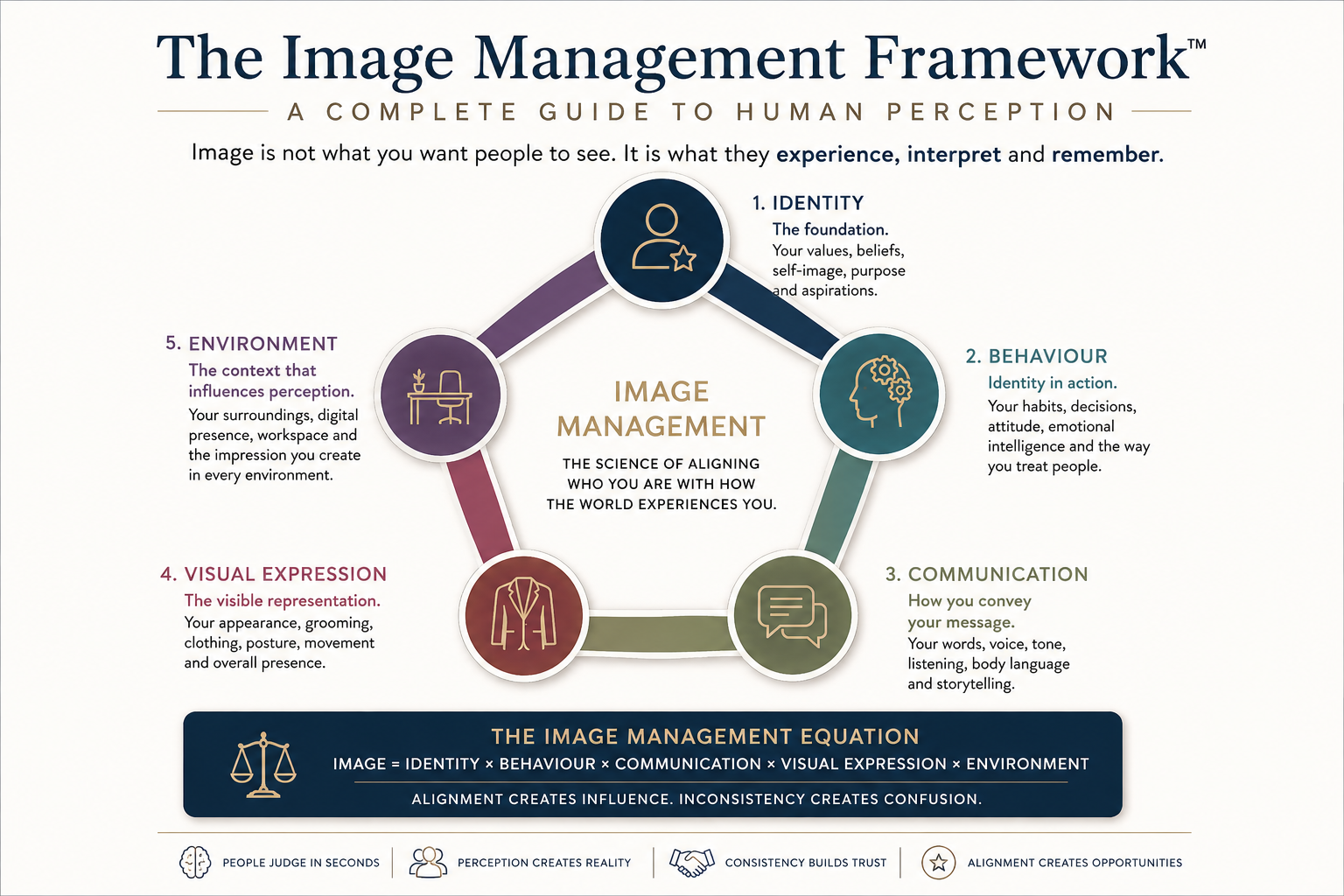
The answer lies in understanding Image Management as an integrated system.
Dimension One
Identity
Everything begins with identity.
Identity answers the question:
Who are you when no one is watching?
It includes your values, beliefs, motivations, aspirations and self-image.
Without clarity at this level, every external improvement becomes temporary.
Appearance without identity creates performance.
Identity creates authenticity.
Dimension Two
Behaviour
Identity becomes visible through behaviour.
How you make decisions.
How you handle conflict.
How you treat people.
How you listen.
How you respond under pressure.
Behaviour is where credibility begins to take shape.
Dimension Three
Communication
People experience us through language.
Not only what we say.
But how we say it.
Voice.
Tone.
Vocabulary.
Listening.
Questions.
Stories.
Silence.
Communication transforms internal thinking into external influence.
Dimension Four
Visual Expression
Only now do we arrive at appearance.
Clothing.
Colour.
Fit.
Grooming.
Accessories.
Posture.
Movement.
Visual harmony.
Appearance should never dominate identity.
It should support it.
The objective is not to become fashionable.
It is to become believable.
Dimension Five
Environmental Influence
The final dimension is often ignored.
Yet it shapes perception continuously.
The room you work in.
The background behind your camera.
Your office.
Your digital presence.
Your LinkedIn profile.
Your website.
Even your handwriting.
People do not experience us in isolation.
They experience us within contexts.
Those contexts influence perception.
The Image Management Equation
Most people try to improve one dimension.
They buy better clothes.
Attend a communication workshop.
Hire a leadership coach.
The results remain inconsistent because perception is created by alignment, not isolated improvement.
I define Image Management as:
Image = Identity × Behaviour × Communication × Visual Expression × Environment
This is not a mathematical equation. It is a conceptual one.
If one dimension is significantly out of alignment, it weakens the overall perception.
A polished appearance cannot compensate for poor behaviour.
Strong communication cannot completely overcome a confused identity.
Professional competence loses impact when it is consistently presented through contradictory signals.
Influence grows when all five dimensions reinforce one another.
From Appearance to Influence
Many professionals ask:
"How can I look more confident?"
A more useful question is:
"How can I become easier to trust?"
Trust is built when people experience consistency.
When your appearance supports your expertise.
When your communication reflects your values.
When your behaviour reinforces your message.
When your environment aligns with your standards.
Influence is rarely created by a single impressive moment.
It is created by repeated consistency.
Why This Matters in the Age of AI
Artificial intelligence is changing how knowledge is accessed.
Technical expertise is becoming easier to obtain.
Information is abundant.
What remains difficult to replicate is human perception.
Leadership.
Trust.
Executive presence.
Credibility.
Authenticity.
Emotional connection.
These are becoming the true differentiators.
Image Management is therefore no longer a finishing school concept.
It is a strategic capability.
The Future of Image Management
The discipline is evolving beyond appearance.
Tomorrow's professionals will need to manage:
- Physical presence.
- Digital identity.
- Executive perception.
- Emotional intelligence.
- Cultural adaptability.
- AI-assisted communication.
- Personal brand consistency.
- Self-image and resilience.
The future belongs to those who understand that perception is not manipulation.
It is the alignment of who you are with how the world experiences you.
Final Thought
People often ask:
"What should I wear?"
Rarely do they ask:
"What experience do I create when someone meets me?"
That is the more important question.
Because your image is not the outfit you wear.
It is the conclusion people reach after experiencing you.
And that conclusion shapes opportunities long before your qualifications have the chance to speak.
Frequently Asked Questions.
1. What is Image Management?
Image Management is the strategic process of aligning your identity, behaviour, communication, appearance and environment to create authentic, credible and consistent perceptions. It extends far beyond fashion or grooming and focuses on how people experience you professionally and personally.
2. Is Image Management only about dressing well?
No. Appearance is only one part of Image Management. True Image Management also includes communication, emotional intelligence, behaviour, executive presence, self-image, leadership perception and personal branding.
3. What is the difference between Image Management and Image Consulting?
Image Management is the broader discipline that studies how human perception is formed and managed.
Image Consulting is the professional practice of helping individuals or organisations improve various aspects of their image using the principles of Image Management.
4. Why is Image Management important?
People form impressions within seconds of meeting someone.
These impressions influence trust, credibility, leadership perception, hiring decisions, business relationships and opportunities.
Effective Image Management helps ensure these impressions accurately reflect your capabilities and values.
5. Who needs Image Management?
Image Management benefits:
- Business leaders
- Entrepreneurs
- Corporate professionals
- Sales professionals
- Trainers and coaches
- Job seekers
- Public speakers
- Women rebuilding confidence after career breaks
- Students preparing for professional careers
Anyone whose success depends on influencing others can benefit from understanding Image Management.
6. What are the five dimensions of The Image Management Framework™?
The framework consists of:
- Identity.
- Behaviour
- Communication
- Visual Expression
- Environment
These five dimensions work together to shape how people perceive and experience an individual.
7. How does Image Management affect executive presence?
Executive presence is created when a leader's appearance, communication, behaviour and confidence consistently reinforce their expertise and credibility.
Image Management provides the structure for developing that consistency.
8. Can Image Management improve confidence?
Image Management does not create confidence on its own.
However, when your external presentation aligns with your identity and values, it can reinforce self-confidence and help reduce the gap between how you see yourself and how others experience you.
9. What role does psychology play in Image Management?
Psychology explains how people form impressions, interpret behaviour, build trust and assign credibility.
Image Management applies these insights to help individuals communicate their strengths more effectively.
10. Is Image Management relevant in the age of AI?
Yes. As AI makes technical knowledge more accessible, human qualities such as trust, credibility, executive presence, communication and authentic relationships become even more valuable.
Image Management helps individuals strengthen these uniquely human differentiators.
-1785404072-1_crop.jpeg "Suman Agarwal")