- July 30, 2026
- By Suman Agarwal
Self-Image vs Self-Esteem: Understanding the Difference (And Why It Matters More Than You Think)
Introduction
Ask someone,
"Do you have confidence?"
Most people immediately think about self-esteem.
They assume confidence comes from feeling good about themselves.
But after working with thousands of professionals, entrepreneurs, leaders and individuals over the years, I have realised something profound.
Many people have high self-esteem but a poor self-image.
Others have excellent self-image but surprisingly low self-esteem.
And some struggle with both.
Yet society continues to use these terms interchangeably.
This misunderstanding affects careers, relationships, leadership, parenting and even mental well-being.
If we fail to distinguish between self-image and self-esteem, we often end up solving the wrong problem.
Someone tries to become more confident by repeating affirmations.
Another buys expensive clothes hoping to feel better.
Someone else pursues promotions believing success will finally make them confident.
Sometimes these approaches help.
Often they don't.
Because confidence is far more complex than we imagine.
To understand confidence, we must first understand ourselves.
And that begins by separating two concepts that are closely connected—but fundamentally different.
What Is Self-Image?
Imagine closing your eyes and answering one question.
Who do you believe you are?
Not what others say.
Not your qualifications.
Not your salary.
Not your social media profile.
Who do you believe you are?
That answer represents your self-image.
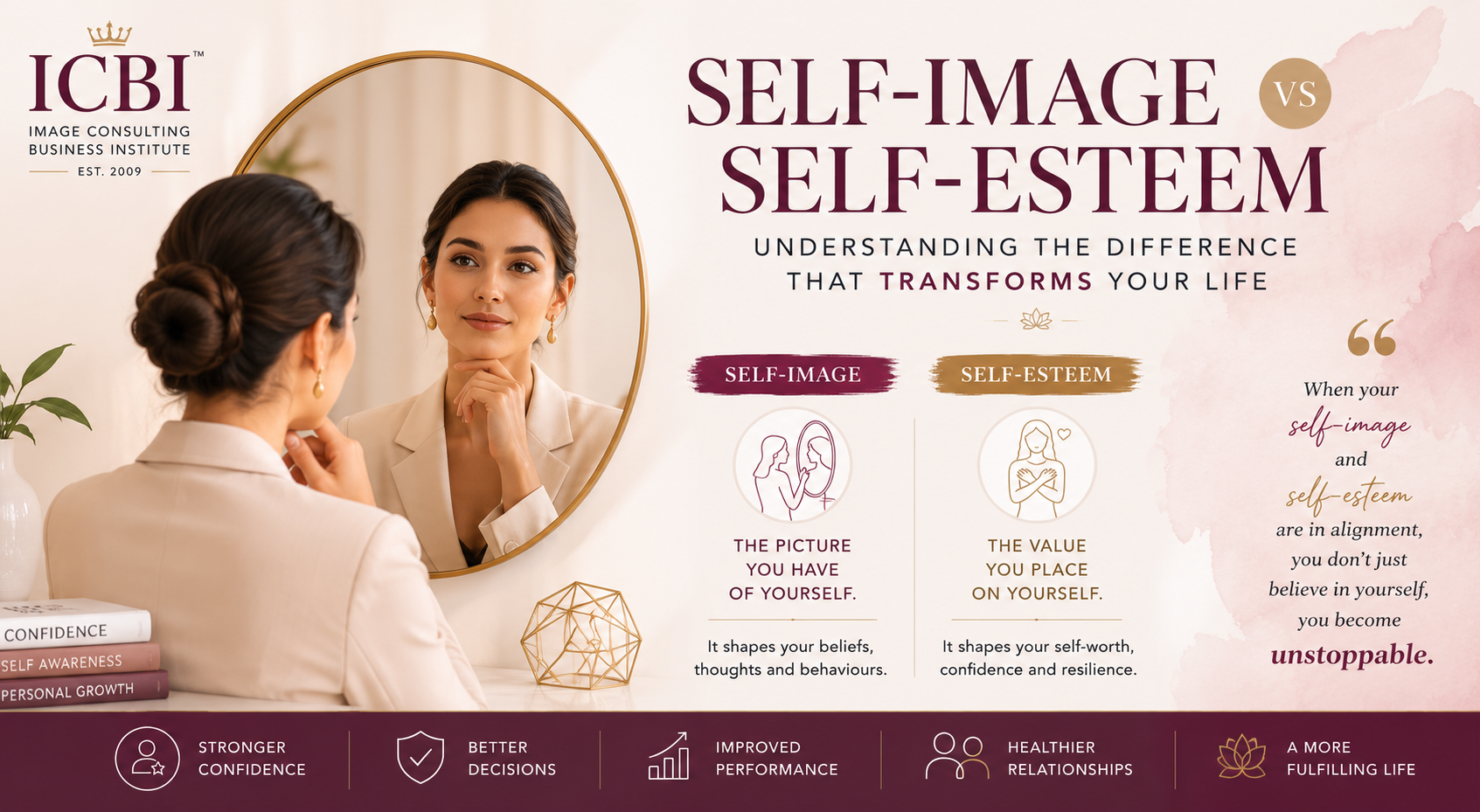
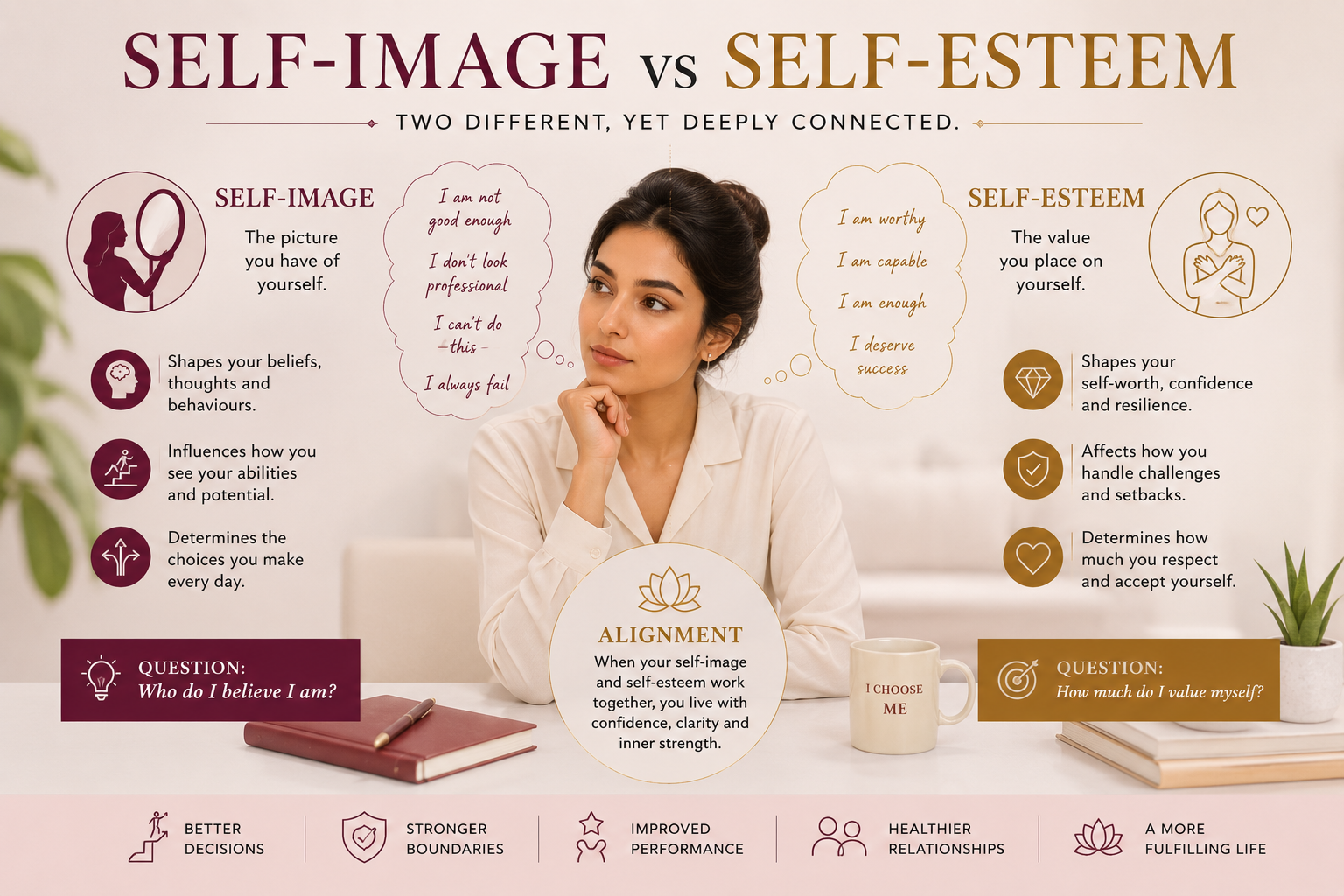
Self-image is the internal picture you carry about yourself.
It is the story you silently repeat every day.
Some people see themselves as capable.
Others see themselves as ordinary.
Some believe they are leaders.
Others constantly feel inadequate despite remarkable achievements.
This internal picture influences almost every decision we make.
It determines:
- How confidently we speak.
- Whether we negotiate.
- Whether we ask for opportunities.
- Whether we set boundaries.
- Whether we believe we deserve success.
Long before behaviour becomes visible...
it exists as self-image.
Self-Image Is Not Reality
One of the most fascinating aspects of psychology is this:
Self-image doesn't need to be accurate.
It only needs to be believed.
Two people may have identical qualifications.
Identical experience.
Identical intelligence.
Yet one applies for the promotion.
The other doesn't.
The difference isn't capability.
It's identity.
Human beings consistently behave in ways that protect the identity they believe to be true.
If someone secretly believes,
"I'm not leadership material."
their behaviour will unconsciously support that belief.
They may avoid visibility.
Decline opportunities.
Speak less in meetings.
Apologise excessively.
Not because they lack ability.
But because behaviour follows identity.
This is why changing behaviour without addressing self-image rarely produces lasting transformation.
What Is Self-Esteem?
While self-image answers,
"Who am I?"
Self-esteem answers a different question.
"How much do I value myself?"
Self-esteem refers to the degree of worth, respect and acceptance we have for ourselves.
It reflects how we evaluate our own value as a person.
People with healthy self-esteem generally:
- Respect themselves.
- Accept imperfections.
- Recover more quickly from criticism.
- Feel worthy of love and success.
- Set healthier boundaries.
Notice something important.
Self-esteem is an evaluation.
Self-image is an identity.
One measures worth.
The other defines self.
Self-Esteem Can Rise and Fall
Unlike self-image, self-esteem often fluctuates.
A successful presentation may increase it.
Failure may reduce it.
Praise can strengthen it.
Criticism can weaken it.
This doesn't mean self-esteem is unstable.
It simply responds more readily to life experiences.
Self-image, however, tends to remain remarkably consistent unless consciously challenged.
That's why someone who has always believed,
"I'm not good enough,"
may continue believing it even after receiving promotions, awards or recognition.
The evidence changes.
The identity doesn't.
The Difference That Changes Everything
If I had to explain the distinction in one sentence, it would be this:
Self-image determines who you believe you are.
Self-esteem determines how much you value that person.
Both influence confidence.
But they do so differently.
Imagine two professionals.
The first believes,
"I'm a capable leader."
That's self-image.
The second believes,
"I deserve respect."
That's self-esteem.
Now imagine someone who believes,
"I'm intelligent."
But also believes,
"I'm not worthy."
They may constantly overwork to earn approval.
Conversely, someone may value themselves deeply yet still see themselves as "not creative," "not attractive," or "not entrepreneurial."
Each combination creates different behaviours.
This is why one-size-fits-all confidence advice often falls short.
Why Self-Image Shapes Behaviour More Than Self-Esteem
Here is one of the most important principles in Image Management.
People rarely behave above their self-image for long.
They eventually return to what feels psychologically familiar.
Think of someone who loses a significant amount of weight but still buys oversized clothes.
Or an entrepreneur who builds a successful company yet still introduces themselves apologetically.
Or a woman who receives constant compliments but still believes she isn't attractive.
Nothing is wrong with their external reality.
The challenge lies in their internal identity.
Their self-image has not caught up with their achievements.
This explains why some people sabotage opportunities.
Why others remain invisible despite remarkable talent.
Why certain professionals never negotiate their worth.
Their behaviour isn't random.
It is consistent with the identity they hold.
The Mirror You Carry Inside
Most people believe they look into a mirror every morning.
Psychologically speaking, the opposite is often true.
We look into our self-image first.
Then we interpret the mirror.
The mirror reflects reality.
Self-image interprets it.
Two people can receive the same compliment.
One smiles and says, "Thank you."
The other immediately dismisses it:
"They're just being polite."
The compliment was identical.
The interpretation was not.
This is because we do not always experience reality directly.
We experience reality through the lens of the beliefs we already hold about ourselves.
That inner lens quietly influences our confidence, relationships, communication, career decisions, and willingness to be seen.
And until we become aware of it, it often shapes our lives more than our actual abilities ever do.
PART 2
The Psychology Behind Self-Image
Psychologists have long recognised that our brains do not simply record experiences, they interpret them.
Every experience becomes evidence that either strengthens or weakens the story we tell ourselves.
Imagine a child who is constantly praised for being responsible.
Over time, responsibility becomes part of their identity.
Now imagine another child who repeatedly hears:
"You're careless."
"You're lazy."
"You're not good enough."
Eventually, these statements stop sounding like opinions.
They become identity.
This is one of the reasons self-image is so powerful.
The brain begins to filter new experiences through existing beliefs.
If your self-image tells you that you're not confident, your mind starts collecting evidence to support that belief.
You remember the presentation where you stumbled.
You forget the meeting where you spoke brilliantly.
You notice criticism.
You overlook compliments.
Psychologists call this confirmation bias—our tendency to notice and remember information that supports what we already believe.
This is why changing self-image isn't simply about thinking positively.
It requires changing the evidence your brain repeatedly experiences.
The Invisible Ceiling
One of the greatest consequences of a poor self-image is something I call The Invisible Ceiling.
An invisible ceiling isn't created by society.
It isn't created by your manager.
It isn't created by your family.
It is created by the highest version of yourself that you currently believe is possible.
Think about this.
Why do talented professionals decline promotions?
Why do brilliant entrepreneurs undercharge?
Why do experienced women hesitate to return to work after years away?
Why do leaders remain silent in boardrooms despite having valuable ideas?
In many cases, the obstacle isn't competence.
It is identity.
People naturally pursue opportunities that feel consistent with who they believe they are.
Anything beyond that feels uncomfortable.
This explains why external success doesn't always produce internal confidence.
A person can become more successful without becoming more convinced of their own worth.
Can Success Repair Self-Image?
Most people believe confidence follows achievement.
"If I get promoted..."
"If I lose weight..."
"If my business grows..."
"If people recognise me..."
"...then I'll finally feel confident."
Sometimes that happens.
But not always.
Have you ever met someone incredibly successful who still doubts themselves?
Or someone admired by thousands who secretly feels inadequate?
Success changes circumstances.
It doesn't automatically rewrite identity.
This is why many high achievers continue experiencing imposter syndrome.
Their external world evolves faster than their internal world.
Self-image must eventually catch up.
Otherwise, people spend years trying to earn a feeling that no achievement alone can provide.
Can Appearance Improve Self-Image?
This is perhaps the most misunderstood question in Image Management.
Many people assume appearance has nothing to do with psychology.
Others believe appearance is everything.
The truth lies somewhere in the middle.
Appearance cannot create self-worth.
But it can influence self-perception.
Research in psychology has shown that what we wear can affect how we think, behave and perform, a phenomenon often discussed as enclothed cognition.
When our external presentation aligns with our internal aspirations, it can reinforce a desired identity.
Consider someone preparing for an important presentation.
If they wear clothing that makes them feel professional and authentic, they often stand differently.
Speak differently.
Behave differently.
The clothing hasn't created confidence.
It has reduced the friction between how they see themselves and how they wish to be experienced.
This is where Image Management becomes powerful.
Not because it changes who you are.
But because it helps your external expression support your internal identity.
Why Image Management Begins Inside
For many years, Image Management was associated with grooming, etiquette and wardrobe planning.
While these remain valuable, they are only the visible layer.
True Image Management begins much earlier.
It begins with identity.
Because appearance without identity creates performance.
Identity without expression creates invisibility.
Neither serves the individual.
Real Image Management aligns the internal and the external.
It asks deeper questions:
- Does your communication reflect your values?
- Does your behaviour reinforce your credibility?
- Does your appearance support your aspirations?
- Does your environment reflect your standards?
When these dimensions align, people describe someone as authentic.
Authenticity is not accidental.
It is the result of consistency.
How to Rebuild Self-Image
Changing self-image is not about pretending to be someone else.
It is about gradually replacing outdated beliefs with evidence-based experiences.
Here are five practical steps.
1. Become Aware of Your Inner Narrative
Notice the language you use when talking about yourself.
Do you frequently say:
"I'm not leadership material."
"I'm terrible at networking."
"I'm not creative."
These statements are rarely facts.
They are identity labels.
Replacing them begins with recognising them.
2. Separate Identity from Performance
One poor presentation does not make you a poor communicator.
One rejection does not make you unworthy.
One mistake does not define your identity.
Evaluate behaviour.
Protect identity.
3. Build Evidence, Not Empty Affirmations
Instead of saying,
"I am confident."
Ask,
"What small action today would provide evidence that I am becoming more confident?"
Confidence grows through repeated experiences, not repeated slogans.
4. Align Your External Image
Dress in a way that reflects the person you are becoming—not the version you are trying to leave behind.
Improve communication.
Strengthen posture.
Refine executive presence.
These changes reinforce identity through experience.
5. Surround Yourself with Identity Builders
The people around you influence the story you tell yourself.
Choose environments that challenge your limitations without diminishing your worth.
Growth thrives where encouragement and accountability coexist.
The Image Management Perspective
After years of working with leaders, professionals, entrepreneurs and individuals rebuilding confidence, one observation has remained consistent.
People do not struggle because they lack potential.
They struggle because their self-image has not evolved at the same pace as their capabilities.
This is where Image Management becomes transformative.
It is not about teaching someone to look successful.
It is about helping them create alignment between who they are, who they believe they are, and how the world experiences them.
When identity, behaviour, communication, appearance and environment tell the same story, confidence stops feeling like an act.
It becomes a natural expression of self.
That is the true purpose of Image Management.
Not to manufacture perception.
But to reveal authenticity with clarity and consistency.
Final Thoughts
The world often encourages us to improve our self-esteem.
But perhaps the deeper question is this:
Who have you become in your own mind?
Because every decision you make tomorrow will be influenced less by your qualifications and more by your answer to that question.
Self-esteem helps you value yourself.
Self-image determines what you believe is possible for yourself.
One shapes how you feel.
The other shapes how you live.
And while both deserve attention, lasting transformation begins by changing the picture you carry within.
Because every great life is first imagined internally before it is experienced externally.
The Self-Image Alignment Model™
Every individual can assess themselves across five dimensions:
- Identity – Who do I believe I am?
- Worth – How much do I value myself?
- Behaviour – Do my actions reflect my aspirations?
- Expression – Does my appearance communicate my authentic identity?
- Perception – How do others consistently experience me?
Frequently Asked Questions
What is the difference between self-image and self-esteem?
Self-image is the mental picture you have of yourself—your identity, capabilities and perceived role in the world. Self-esteem is the value and respect you place on yourself. Self-image answers "Who am I?" while self-esteem answers "How much do I value myself?"
Which is more important: self-image or self-esteem?
Both are important, but self-image often has a stronger influence on long-term behaviour because people tend to act consistently with the identity they believe they have.
Can someone have high self-esteem but a poor self-image?
Yes. A person may respect themselves yet still believe they are "not a leader," "not creative," or "not attractive." These beliefs can limit opportunities despite healthy self-worth.
Can self-image be changed?
Yes. Self-image is not fixed. It evolves through awareness, new experiences, supportive environments and intentional changes in behaviour and perception.
How does self-image affect confidence?
Self-image shapes confidence by influencing what you believe you are capable of doing. When people see themselves as capable, they are more likely to take initiative, speak up and pursue opportunities.
Does appearance affect self-image?
Appearance alone cannot create self-worth, but it can reinforce identity. When appearance aligns with values and aspirations, it often strengthens confidence and self-perception.
Why do successful people still struggle with confidence?
Success changes external circumstances, but it does not automatically change internal beliefs. If self-image remains unchanged, people may continue doubting themselves despite visible achievements.
What role does Image Management play in self-image?
Image Management helps create consistency between identity, behaviour, communication, appearance and environment. This alignment strengthens authenticity and supports a healthier self-image.
Can improving self-image improve relationships?
Yes. A healthier self-image often leads to stronger boundaries, clearer communication, reduced need for external validation and more authentic relationships.
Is self-image formed only during childhood?
Childhood plays a significant role, but self-image continues to evolve throughout life. Meaningful experiences, mentors, coaching, personal growth and conscious reflection can reshape it.
-1785404072-1_crop.jpeg "Suman Agarwal")